Article
What I Mean by Practical AI Engineering
Practical AI engineering means building reliable AI systems with backend discipline: clear boundaries, evaluation, observability, and maintainable software around the model.
AI needs better definitions.
Not because every phrase needs to become a category, but because a lot of AI discussion falls into two extremes.
On one side, AI is treated like magic. A model appears, someone posts a demo, and suddenly every existing workflow is supposed to disappear. The language gets vague very quickly. Agents. Automation. Intelligence. Reasoning. Transformation. Most of it sounds impressive until you ask what actually runs in production, what happens when it fails, and who maintains it six months later.
On the other side, the conversation stays close to research papers, model benchmarks, evaluation charts, and release notes. That work matters, but it is not the whole story. Most software engineers are not training frontier models. They are trying to understand how these models fit into real systems.
That middle ground is where I think the useful work is.
AI becomes much more useful when it stops being a demo and becomes part of software.
That is what I mean by practical AI engineering.
This article includes a short glossary at the end for the acronyms used here.
What is practical AI engineering?
Practical AI engineering is the work of designing, building, evaluating, and running AI-powered software systems that solve real problems under real constraints.
The model matters, but the model is not the product.
The product is the system around it.
A useful AI system has inputs, outputs, interfaces, dependencies, permissions, latency limits, cost limits, logging, monitoring, user expectations, fallback paths, and failure modes. It has data moving through it. It has external application programming interfaces (APIs). It has edge cases. It has users who will ask unclear questions, upload bad files, click the wrong thing, and expect the result to make sense anyway.
Engineering is what turns the model into something useful.
It defines what the system is allowed to do. It decides where context comes from. It controls how tools are called. It checks whether the answer is structured correctly. It records what happened. It measures quality. It makes failure visible. It gives humans a way to correct the system when the model gets something wrong.
The novelty is the model.
The discipline is still engineering.
What practical AI engineering is not
Practical AI engineering is not chasing every model announcement.
New models matter, but a better model does not automatically give you a better system. If your retrieval is weak, your tool permissions are too broad, your outputs are unvalidated, and your logs tell you nothing, switching models may only make the same architecture fail in a more expensive way.
It is also not treating prompts as the whole discipline.
Prompts are part of the interface between your software and the model. They are important, but they are not a substitute for architecture. A prompt cannot replace access control. It cannot replace tests. It cannot replace schema validation. It cannot replace observability. It cannot make unclear product requirements clear.
Practical AI engineering is not calling every automation an agent.
Sometimes the right system is a workflow. Sometimes it is a background job. Sometimes it is a search interface with a model-generated summary. Sometimes it is a human approval queue with AI assistance. The word “agent” should describe a real design choice, not decorate an ordinary script.
It is not replacing software engineering with vibes.
If anything, AI makes engineering discipline more important. The model introduces behavior that can vary from one run to another, but the system around it still needs to be predictable enough to trust. That tension is the job.
It is not guru threads, artificial general intelligence (AGI) speculation, or benchmark watching as a lifestyle.
Those things may be interesting, but they are not the same as building AI systems that survive contact with real users, real data, real APIs, real latency, real costs, and real failure modes.
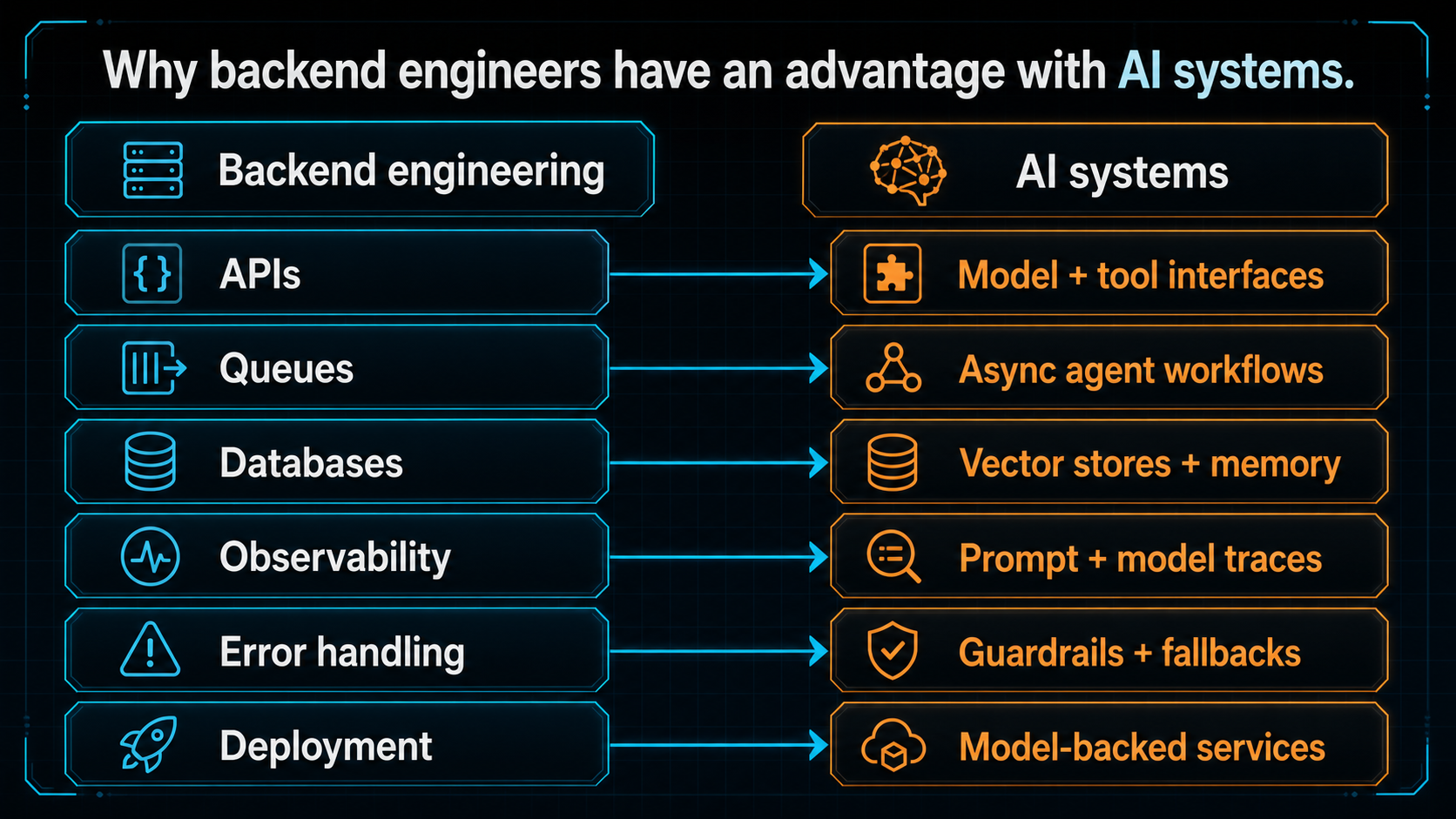
Why backend engineers have an advantage with AI systems
I think backend engineers are in a strong position to work with AI systems.
Not because backend engineering already answers every AI problem, but because many of the instincts transfer.
Backend engineers are used to thinking in contracts. What does this service accept? What does it return? What happens when the dependency is down? What retries are safe? What data can this user access? What should be logged? What should never be logged? What is the cost of this request? What happens under load?
Those questions do not disappear when a large language model (LLM) enters the system.
They become more important.
AI adds new concerns. Model selection matters. Context design matters. Evaluation becomes harder because the same input may not always produce the same output. User experience changes because people write messy natural language instead of clean form fields. Failure modes become more subtle because an answer can be fluent, plausible, and wrong at the same time.
But the foundation is familiar.
You still need boundaries.
You still need interfaces.
You still need to think about data flow.
You still need to handle failure.
You still need to decide what belongs in the system, what belongs in the model call, and what belongs with a human.
Backend engineering and AI are not separate worlds. Practical AI engineering is what happens when backend discipline is applied to AI-powered behavior.
What does a practical AI engineering stack include?
When I think about an AI system, I do not start with “Which model is coolest?”
I usually think in layers.
First, there is the model interface. That may be an LLM API, a local model, or a managed provider. The choice matters, but mainly in relation to the task. Quality, latency, cost, context window, structured output support, tool calling behavior, and operational reliability all matter more than leaderboard position alone.
Then there is context. Most useful AI systems need information that is not inside the model weights. That may come from documents, databases, codebases, tickets, user profiles, logs, or API responses. Retrieval is not just “add retrieval augmented generation (RAG).” It is a design problem. What should be retrieved? How much context is enough? How do you avoid stale or irrelevant context? How do you show provenance?
Then there are outputs. Free text is easy to demo, but production systems often need structure. JavaScript Object Notation (JSON) schemas, typed responses, validation, repair strategies, and clear error handling make AI outputs safer to use in software.
Then there is tool use. If the system can call APIs, search databases, send messages, create files, update records, or trigger workflows, the engineering bar goes up. Tool calling needs permissions, constraints, audit logs, idempotency where possible, and human approval for risky actions.
Then there are agents and workflows. Some systems need multi-step reasoning or autonomous execution. Many do not. The practical question is not “Can I make this agentic?” The practical question is “What degree of autonomy is useful, safe, observable, and worth maintaining?”
Then there is evaluation. You need some way to know whether the system is improving or getting worse. That can include test sets, human review, golden examples, regression cases, task completion rates, refusal quality, citation accuracy, and production feedback loops.
Finally, there is operation. Logs. Traces. Metrics. Cost monitoring. Rate limits. Timeouts. Caching. Deployment strategy. Versioning. Rollbacks. Incident review. The ordinary machinery of software becomes the difference between a clever prototype and a system people can rely on.
Example: turning a document chatbot into a useful internal support assistant
Take a common demo: “Ask questions about a portable document format (PDF) file.”
As a demo, this is easy to understand. Upload a document, ask a question, get an answer. It feels useful immediately.
But a practical internal support assistant needs more than that.
It needs to know which documents are allowed for which users. It needs document provenance, so the answer can point back to the source. It needs retrieval that finds the right section, not just semantically similar noise. It needs to admit uncertainty when the document does not answer the question. It needs citations that are real, not decorative.
It needs to track unanswered questions, because those are product signals. Maybe the documentation is missing something. Maybe the retrieval is weak. Maybe users are asking for a workflow the company has never written down.
It needs latency controls. If every answer takes twenty seconds, people will stop using it. It needs cost controls. If every simple question triggers a large model with a huge context window, the system may be technically correct and economically unserious.
It needs human correction. When someone marks an answer as wrong, where does that feedback go? Does it improve the document? Does it create a review task? Does it become part of an evaluation set?
It needs monitoring. Which questions are asked most often? Which documents are used? Which answers have low confidence? Which failures are silent?
The difference between the demo and the practical system is not glamour.
It is engineering.
What I will write about here
This site will be about that middle ground.
I want to write about LLM applications, useful agents, tool use, Model Context Protocol (MCP), retrieval, automation workflows, backend architecture, evaluation, reliability, and the tradeoffs that show up when AI leaves the demo environment.
Some posts will be conceptual. Some will be implementation notes. Some will be lessons from building in public. I expect my own thinking to change as the tools change and as I build more systems with them.
But the standard should stay stable.
The question is not only “Can AI do this?”
A better question is:
What would it take to make this useful, reliable, and worth maintaining?
That question is less exciting than a viral demo.
It is also where the real work begins.
Glossary
Terms used in this article
- AI - Artificial Intelligence
- Model-powered software behavior used inside a larger engineered system.
- API - Application Programming Interface
- A contract that lets software systems communicate.
- LLM - Large Language Model
- The model component that can generate or transform language, code, and structured output.
- RAG - Retrieval Augmented Generation
- A pattern that gives a model relevant external context before it answers.
- JSON - JavaScript Object Notation
- A common structured data format used for API responses and validated model outputs.
- MCP - Model Context Protocol
- A protocol for connecting AI applications to external tools and context sources.
- AGI - Artificial General Intelligence
- A speculative broad form of AI, not the focus of practical AI engineering.
- PDF - Portable Document Format
- A common document format often used in retrieval and document-assistant examples.